
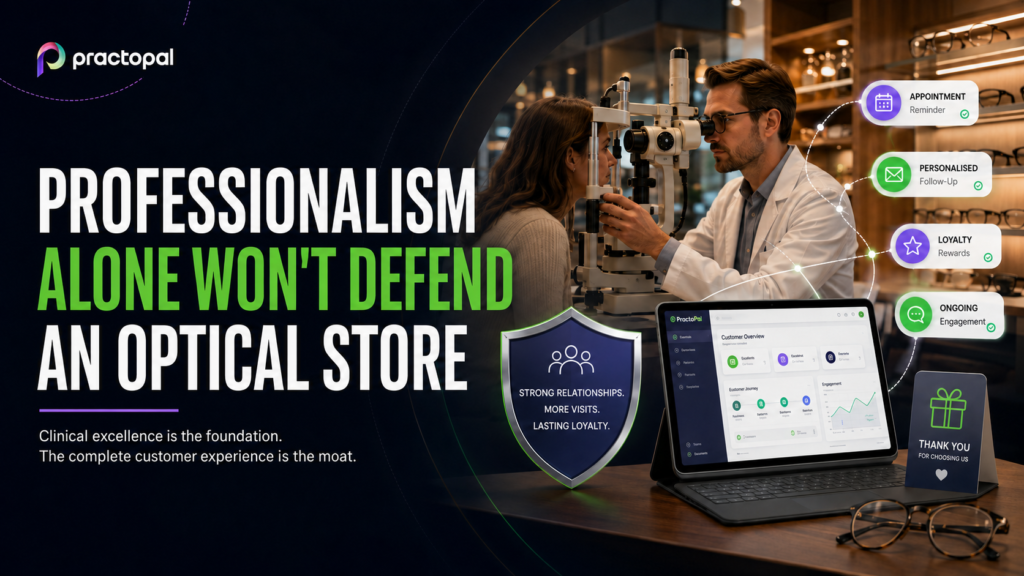
Professionalism Is Essential—But Is It Still a Competitive Moat for Optical Retailers?
Clinical professionalism is the foundation of a trusted optical business, but it should not be treated as an exclusive competitive advantage. As professional eye care continues to develop across Malaysia, Singapore optical retailers need to differentiate through continuity, convenience, personalisation and measurable long-term care.
Singapore optical retailers rightly take pride in professional standards, accurate dispensing and responsible patient care. These strengths remain critical. Customers are entrusting a practice with their sight, prescription and health information, so clinical quality must never be compromised.
But professionalism alone may not protect a business from growing cross-border competition.
Malaysia has registered optometrists, established optical practices, university-trained professionals and a regulated eye-care sector. Its Ministry of Health has also discussed further strengthening the regulation of optometry and primary eye care. Singapore retailers should therefore avoid building their strategy around the assumption that customers cannot receive credible professional care across the border.
Professional care is the entry requirement, not the entire moat
In a competitive market, professionalism functions like accuracy, cleanliness and product authenticity: customers expect it. Strong standards build trust, but good competitors may be able to meet the same baseline.
A true competitive moat is something valuable that is difficult for another retailer to reproduce quickly. For an optical practice, that moat may include:
- Years of connected prescription and clinical history
- A team that understands the patient’s preferences and concerns
- Consistent follow-up after every important visit
- A structured care plan with clear future reviews
- Easy access to appointments, records and support
- Relevant benefits based on the customer’s actual needs
- Reliable service across every branch and staff member
A competitor can stock the same frame or offer the same lens brand. Reproducing a well-managed patient relationship built over several years is considerably harder.
Why products are becoming less defensible
Many optical products are distributed across multiple markets. Customers may recognise the same international frame brands, spectacle lens manufacturers and contact lens products in both Singapore and Malaysia.
When the product appears identical, customers naturally focus on visible differences such as price, promotions and convenience. Simply explaining that a store provides “good service” may not overcome a significant perceived saving.
The retailer must make less visible value more visible.
Turn clinical work into visible customer value
Show changes over time
A single prescription is a snapshot. A connected prescription history tells a story. Showing how a patient’s vision has changed helps them understand why regular reviews and consistent records matter.
Explain the care pathway
Patients should leave knowing what was found, what they need to monitor and when they should return. A clear next step transforms an isolated examination into an ongoing care relationship.
Follow up proactively
A short check-in after progressive lens dispensing, first-time contact lens wear or a myopia-management review demonstrates accountability. It also gives the practice an opportunity to resolve concerns before dissatisfaction grows.
Remember meaningful preferences
Customers appreciate not having to repeat everything. Frame fit preferences, previous lens designs, contact lens parameters, communication preferences and family relationships can help the team provide a more relevant experience.
Make continuity independent of one staff member
A relationship should not disappear when a team member is on leave or changes employment. Structured records allow the practice—not only an individual practitioner—to maintain continuity.
From professional transaction to connected care
Consider two customer experiences.
In the first, the customer receives a competent eye examination, purchases spectacles and hears nothing from the store until they return voluntarily.
In the second, the examination findings and prescription are properly recorded, the new product is linked to the patient record, the team checks on adaptation, and the customer receives a relevant reminder when the next review is due.
Both stores may be professional. The second has created continuity—and continuity creates a stronger reason to stay.
How technology supports rather than replaces professionalism
Technology should not attempt to replace the clinical judgement or human care provided by optometrists and opticians. Its role is to ensure that important information and follow-up actions are not lost in busy daily operations.
PractoPal helps optical teams connect prescription history, patient records, clinical notes, purchases, appointments and communications. This gives practitioners a clearer view of the patient and helps the business deliver professional care consistently at scale.
The future competitive advantage is not professionalism versus technology. It is professionalism made more consistent, visible and connected through technology.
Frequently asked questions
Are optometrists regulated in Malaysia?
Yes. Optometrists and opticians practise within Malaysia’s regulatory framework, and the country has continued discussing measures to strengthen the regulation and quality of primary eye care.
Does this mean clinical quality is no longer important?
No. Clinical quality is essential and should never be reduced. The point is that professionalism must be combined with continuity, convenience and engagement to form a stronger competitive position.
What makes an optical practice difficult to replace?
Connected patient history, trusted relationships, proactive follow-up, structured care programmes and convenient access collectively make a practice harder to replace than a store competing only through products.
Turn good professional care into lasting patient relationships
Discover how PractoPal connects patient records, prescription history, appointments and follow-ups to support continuity of care.
Further reading: Malaysia’s proposed optometry regulation and primary eye-care development.