
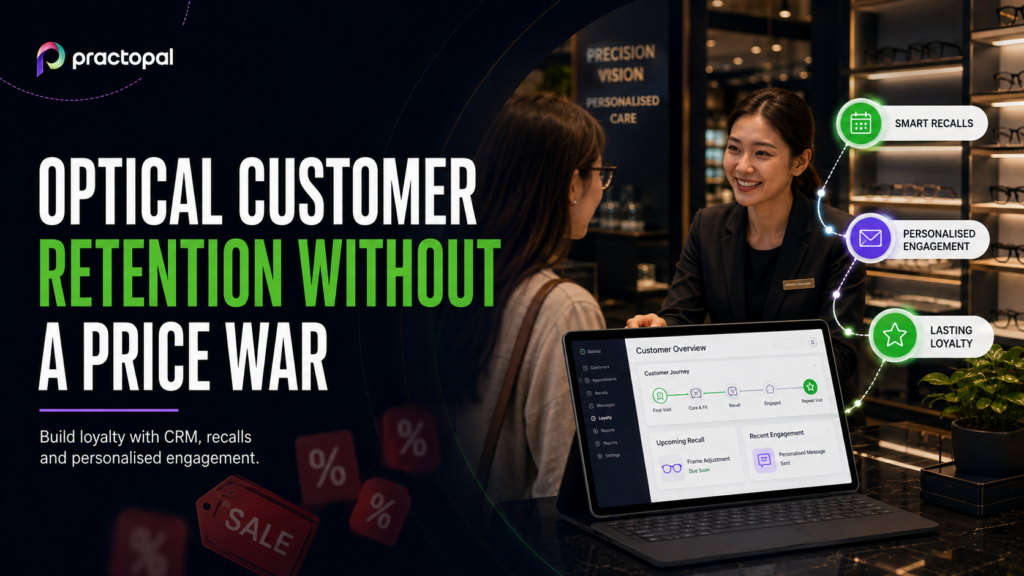
Stop Competing Only on Price: Build an Optical Customer Relationship That Is Hard to Replace
Singapore optical retailers are unlikely to build a sustainable defence through discounts alone. A stronger retention strategy uses customer data, timely recalls, personalised communication and ongoing care to make the relationship more valuable than a single price comparison.
When customers can find the same frame, spectacle lens or contact lens product elsewhere for less, discounting feels like the most direct response. Reduce the price, match the promotion or give a larger voucher—and perhaps the customer will stay.
This may work for an individual transaction, but it is rarely a durable strategy. A competitor can introduce another promotion. Cross-border price differences may be structural. Repeated discounting can also reduce margins and train customers to delay purchases until the next offer.
The better question is not, “How do we make every product cheaper?” It is, “How do we make the overall relationship more valuable?”
Why price is a weak long-term defence
Price is highly visible and easy to compare. This makes it powerful, but also difficult for an independent retailer to own.
Overdependence on discounting can create several problems:
- Lower gross margins and less capacity to invest in staff and service
- Customers who wait for promotions instead of buying when needed
- Reduced perceived value of professional care
- Offers sent to customers who would have purchased without a discount
- Little meaningful difference between competing stores
This does not mean promotions should disappear. It means promotions should have a defined purpose, audience and measurement plan.
Use customer data to create relevance
Most optical retailers already possess valuable data: prescriptions, purchase history, appointment dates, contact lens parameters, product preferences and family relationships. The problem is often that this information sits in disconnected systems or is not used after the transaction.
A connected optical CRM can identify practical customer segments such as:
- Patients overdue for an eye examination
- Contact lens customers approaching their expected replenishment date
- Children due for a myopia-management review
- Progressive lens wearers who may need an adaptation follow-up
- Customers with unredeemed or expiring vouchers
- Previously frequent customers who have become inactive
- Families with only one member currently visiting the practice
Each group has a different reason to return. Sending all of them the same message wastes attention and can weaken trust.
Create a structured optical retention calendar
Retention should be designed around the customer’s care and product cycle. A simple framework could include:
Immediately after purchase
Send a receipt, collection information and clear instructions about what happens next.
Three to seven days after collection
Check comfort, vision and adaptation where appropriate. Invite the customer to contact the store if an adjustment is needed.
Thirty days after collection
Follow up on products that commonly require adaptation or ongoing support, especially progressives and new contact lens modalities.
At the relevant replenishment point
Remind eligible contact lens customers before they run out. If a clinical review is due, guide them to an appointment instead of treating the interaction as a simple reorder.
At six or twelve months
Trigger the relevant clinical recall based on age, condition, treatment plan and professional judgement.
The goal is not constant messaging. The goal is useful communication at moments when the customer is likely to need support.
Reward valuable behaviour, not only spending
Traditional loyalty programmes tend to reward transaction value. Optical retailers can think more broadly by recognising behaviours that strengthen health outcomes and relationships.
Examples include benefits for attending scheduled reviews, completing an annual eye examination, referring a family member, participating in a care programme or consolidating household eye care with one practice.
Digital vouchers can support these programmes, but they should be targeted. A contact lens customer may value a replenishment benefit, while a parent may respond better to a family eye-care or myopia-review offer.
Measure whether retention is improving
Daily sales provide only part of the picture. Retailers should also monitor:
- Returning-customer rate
- Recall-to-appointment conversion
- Contact lens repurchase rate
- Average time between visits
- Lapsed-customer recovery
- Voucher redemption and resulting revenue
- Customer lifetime value
These measures help distinguish activity from results. Sending 5,000 messages is not success if few customers book, return or purchase.
How PractoPal supports optical customer retention
PractoPal brings customer profiles, prescriptions, purchases, appointments, recalls, marketing and voucher performance into one optical retail system. Retailers can segment their database, identify customers due for action, send more relevant campaigns and track what happens afterward.
Price will always matter. But when a customer feels known, supported and proactively cared for, price becomes one factor rather than the entire relationship.
Frequently asked questions
What is customer retention in optical retail?
Optical customer retention is the ability to keep patients and customers returning for appropriate eye examinations, follow-ups, product replacement and future purchases over time.
How can an optical store improve its recall rate?
Maintain accurate review dates, segment patients by recall reason, automate timely reminders, make booking easy and follow up systematically with customers who do not respond.
Should optical retailers stop offering discounts?
No. Discounts can be effective when they are targeted, time-bound and measured. They should support a retention strategy rather than replace one.
Build retention around your customer data
See how PractoPal helps optical retailers automate recalls, segment customers, issue digital vouchers and measure campaign performance.