
Optical retail strategy
Lenskart’s Southeast Asian Model Shows Where Integrated Optical Retail Is Heading
Confirmed company strategy · Expansion signal
Lenskart’s regional growth is more than a store-expansion story. It shows how integrated supply chains, connected customer journeys and faster fulfilment are becoming part of the competitive model for optical retail in Southeast Asia.
Direct answer
Lenskart’s Southeast Asian strategy indicates that the next phase of optical retail competition will be built on connected operations, not store count alone. Its model combines physical outlets with a central catalogue, supply-chain control, digital ordering, rapid fulfilment and continuing customer relationships.
Independent optical retailers cannot reproduce the scale of a large regional chain. They can, however, use optical management software to gain many of the same operating capabilities: accurate stock visibility, centralised purchasing, shared customer records, consistent product data, mobile access and structured loyalty programmes.
What Lenskart has reported
In a shareholder letter dated 11 February 2026, Lenskart reported that Singapore, its first international market, had reached 69 stores. The company also described a combined footprint of 78 stores in Thailand as it introduced the Lenskart brand into that market.
The same company materials described a market-by-market consolidation and localisation strategy across Malaysia, Cambodia, the Philippines, Vietnam and Indonesia. This is significant because it points to a regional operating system rather than a collection of disconnected country businesses.
Lenskart Singapore has also promoted contact-lens self-ordering kiosks with same-day delivery for qualifying orders. These initiatives connect store access, self-service ordering and fulfilment instead of treating each channel as a separate experience.
These figures should be read as company-reported positions from February 2026, rather than a real-time count of stores today. Even with that qualification, the strategic direction is clear.
Why this matters for optical retailers
The most consequential signal is not that a large chain is opening more outlets. Large retailers have always had greater access to capital, purchasing power and brand visibility. The deeper shift is that those advantages are increasingly being connected through software and supply-chain infrastructure.
A customer can discover a product online, visit a physical outlet, be recognised across locations, place an order through a digital interface and receive the product quickly. Behind that experience is a consistent catalogue, accurate inventory, coordinated purchasing and a shared customer record.
This changes what customers may come to expect from every optical retailer, including independent stores. Convenience, visibility and continuity are gradually becoming part of the service baseline.
The emerging integrated optical retail model
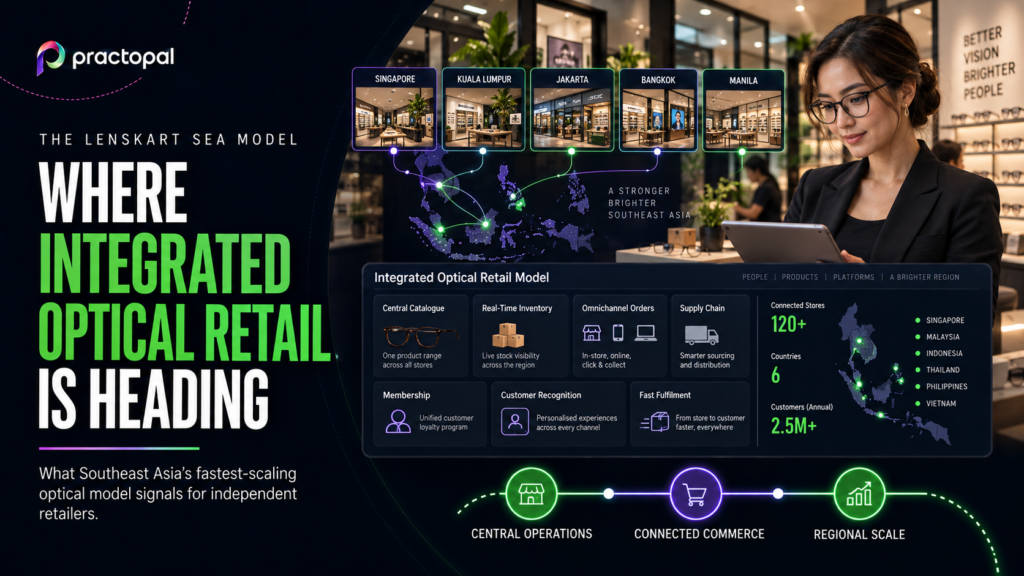
Central catalogue + integrated supply chain + fast fulfilment + membership + omnichannel ordering + physical retail
Each component strengthens the others. A central catalogue makes product data consistent. Integrated purchasing and inventory improve availability. Store-to-store visibility increases the chance of fulfilling demand without unnecessary purchasing. Customer recognition supports continuity across outlets. Membership and loyalty create reasons to return. Digital ordering extends the store beyond its physical opening hours.
The competitive advantage therefore comes from the system working as a whole. Adding an online store without synchronised inventory, or launching a loyalty programme without connected customer records, creates more channels but not necessarily a better customer experience.
Where independent optical retailers can compete
Independent retailers still hold meaningful advantages. They can build strong local relationships, exercise professional judgment, respond quickly and deliver highly personalised care. Many customers value continuity with an optometrist or optical team they know.
The challenge is that these strengths are often supported by fragmented operations. Product details sit in spreadsheets, patient records are separated from sales, stock availability depends on a phone call, and customer follow-up relies on individual memory.
Software does not turn an independent retailer into a large chain. It helps prevent operational limitations from weakening the independent retailer’s strongest differentiators.
PractoPal’s role as shared infrastructure
PractoPal is built to give independent optical retailers and small-to-mid-sized chains access to connected optical retail infrastructure without having to build their own technology stack.
The priority capabilities are:
- Supplier catalogue synchronisation: Maintain cleaner and more consistent product information between suppliers and retailers.
- Centralised purchasing: Coordinate buying, approvals and receiving across outlets.
- Real-time inventory: Understand available, allocated and moving stock more accurately.
- Store-to-store stock visibility: Find products within the group before losing a sale or placing another order.
- Customer recognition across outlets: Give authorised teams access to relevant customer, purchase and prescription history.
- Mobile ordering and access: Allow teams and customers to interact beyond a fixed checkout counter.
- Same-day or scheduled fulfilment workflows: Coordinate order status, collection and delivery expectations.
- Membership and loyalty: Connect vouchers, promotions, rewards and customer engagement to one profile.
PractoPal brings POS, inventory, purchasing, patient records, appointments, CRM, analytics, payments, vouchers and customer engagement into one optical-first platform. That connected foundation helps smaller retailers operate with greater visibility while preserving their identity and personal service.
A practical action plan for optical retailers
- Clean the catalogue. Standardise brands, models, colours, sizes, costs and selling prices.
- Connect inventory to sales. Ensure stock movements reflect purchasing, transfers, sales, returns and adjustments.
- Create one customer view. Bring purchases, prescriptions, appointments and engagement history together with appropriate permissions.
- Define fulfilment choices. Make collection, delivery and expected completion times clear.
- Build retention into operations. Use recalls, relevant messages, loyalty and service follow-ups consistently.
- Measure the complete journey. Review availability, fulfilment time, repeat visits, customer response and performance across locations.
The objective is not to copy Lenskart feature for feature. It is to identify the operational capabilities customers will increasingly expect and implement them at a scale that fits the business.
Frequently asked questions
What is integrated optical retail? Integrated optical retail connects product data, purchasing, inventory, customer and patient records, physical stores, digital ordering and fulfilment so they operate as one system rather than separate channels.
Can independent optical retailers compete with large chains? Yes. Independents can differentiate through professional care, local trust and personal service. Connected software helps them add speed, visibility and consistency without copying the scale or identity of a large chain.
Does an optical retailer need multiple outlets to benefit? No. A single store benefits from accurate inventory, connected patient and customer records, better purchasing and structured follow-up. A scalable system also reduces the need to change platforms when the business grows.
Which capabilities should a growing optical retailer prioritise first? Begin with reliable product data, inventory visibility, connected customer records and consistent sales and purchasing workflows. Add digital ordering, fulfilment options and loyalty once the operational foundation is dependable.
How does PractoPal support integrated optical retail? PractoPal connects POS, inventory, purchasing, patient records, appointments, CRM, analytics and customer engagement in one platform designed specifically for optical retailers of different sizes.
Conclusion
Lenskart’s Southeast Asian strategy is a competitive signal for the whole optical retail market. The emerging advantage is not simply more outlets. It is the ability to connect catalogue, supply chain, stores, customers and fulfilment into one operating model.
Independent retailers do not need to become large chains to respond. They need infrastructure that turns their existing expertise, relationships and service quality into a more connected customer experience. This is where PractoPal can play a strategic role: making chain-level operating capabilities practical and accessible for independent optical retailers and growing groups.