
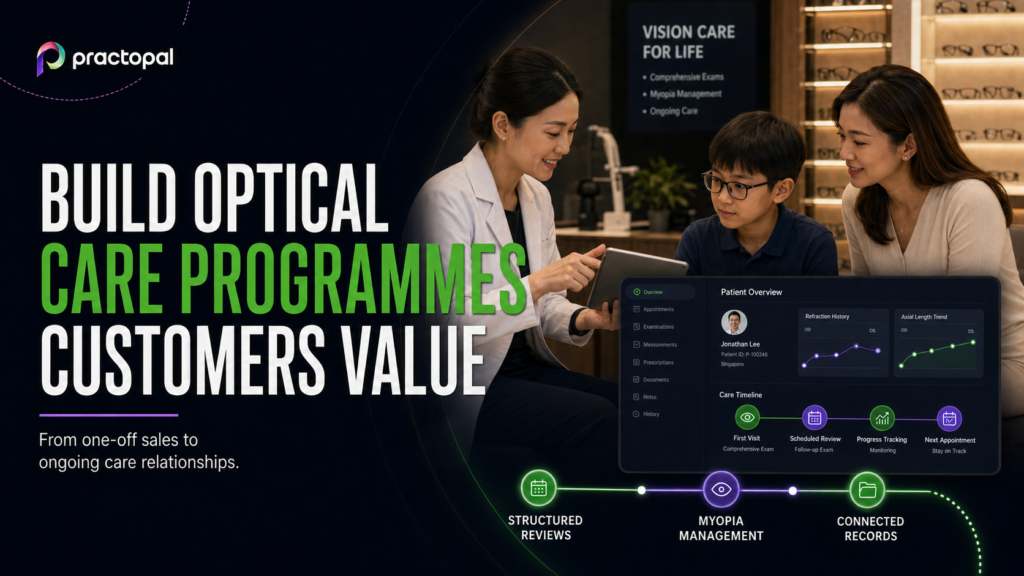
From Transaction to Care Programme: Give Optical Customers More Reasons to Stay
An individual eyewear product is easy to compare across retailers. A structured programme that combines professional care, scheduled reviews, progress tracking, education and ongoing support is far harder to replace. Optical retailers can improve defensibility by turning suitable transactions into continuing care relationships.
A pair of spectacles is a product. An annual vision-care programme is a relationship.
This distinction matters as Singapore customers gain more retail and eye-care choices. If a customer compares only a frame model or contact lens multipack, price is immediately visible. When the decision includes clinical history, scheduled reviews, convenient follow-up and measurable progress, the comparison becomes more meaningful than product price alone.
Why isolated transactions are easier to lose
In a transaction-led model, the customer visits, receives an examination, buys a product and leaves. Unless the customer remembers to return, the relationship may become inactive for one or two years.
This model creates several vulnerabilities:
- The store has few meaningful interactions between purchases.
- The customer may not understand why ongoing reviews matter.
- A competitor can easily offer the same or a similar product.
- Important changes in vision or product performance may go unmonitored.
- The next purchase becomes a fresh price comparison.
A care programme creates a defined reason, date and purpose for the next interaction.
What is an optical patient care programme?
An optical patient care programme is a structured series of services and follow-ups organised around a patient’s needs over a defined period. It is not simply a prepaid discount package. The programme should have a clinical or service objective, clear inclusions and documented next steps.
Depending on the practice and the practitioner’s scope, a programme might include:
- An initial assessment and baseline measurements
- Scheduled eye examinations or clinical reviews
- Prescription and eye-health monitoring
- Contact lens fitting and aftercare
- Myopia progression monitoring
- Frame adjustments and product servicing
- Education and compliance support
- Priority appointment access
- A documented recommendation for the next review
Which customer groups are suitable?
Children undergoing myopia management
Myopia management requires more than dispensing a product. Parents need to understand progression, treatment response, wearing compliance and the importance of scheduled reviews. Connected records make the value of continued monitoring more visible.
Ortho-K patients
Ortho-K care may involve fit assessment, corneal topography, visual outcomes, wearing time, lens care and multiple follow-ups. A structured workflow can help the practice document progress and ensure important checks are completed.
Contact lens wearers
Contact lens customers benefit from regular aftercare, parameter history, replenishment support and appropriate escalation when a review is due. Convenience should work alongside clinical governance.
Progressive lens users
First-time or complex progressive wearers may need adaptation support and adjustments. A proactive follow-up can improve confidence and help resolve issues early.
Families
A family eye-care programme can coordinate appointments and recalls for parents, children and older family members while respecting individual consent and records.
Make clinical progress visible
Customers cannot value what they cannot see or understand. Retailers and practitioners should clearly communicate relevant changes over time.
Depending on the treatment and professional scope, this may include:
- Prescription changes between visits
- Documented treatment milestones
- Visual acuity and relevant clinical findings
- Myopia progression measurements
- Attendance and wearing compliance
- Product changes and reasons for those changes
- The recommended date and objective of the next review
The purpose is not to overwhelm patients with data. It is to explain the value of continuity in language they can understand.
Build the operational foundation
A care programme succeeds only when the business can deliver it consistently. Before launch, define:
- Who qualifies for the programme?
- What services and reviews are included?
- Which data must be recorded at each stage?
- Who is responsible for follow-up?
- What happens when a patient misses a review?
- How will outcomes, renewals and satisfaction be measured?
Without structured systems, care programmes can become dependent on staff memory. That creates inconsistency and makes growth difficult.
How PractoPal supports recurring optical care
PractoPal connects patient records, prescription history, appointments, purchases, communications and treatment information. Its myopia-management workflows are designed to help practices document treatment plans and ongoing reviews in a more structured way.
With clearer records and automated reminders, teams can spend less time searching for information and more time supporting the patient.
A competitor may be able to sell the same product. It is much harder to replace a practice that understands the patient’s history, monitors progress and has already planned the next step in their care.
Frequently asked questions
Is an optical care programme the same as a membership plan?
Not necessarily. A membership may focus on commercial benefits, while a care programme is organised around ongoing services, reviews and patient needs. The two can be combined if the inclusions and responsibilities are clear.
How do care programmes improve retention?
They establish a meaningful reason and timeline for the next interaction, demonstrate continuity, improve follow-up and make the value of the relationship more visible.
Can software make clinical recommendations?
Software can organise information, workflows and reminders, but clinical decisions should remain with appropriately qualified professionals applying their judgement to the individual patient.
Turn one-off purchases into connected care journeys
Explore how PractoPal can support patient history, appointments, myopia-management records, treatment follow-ups and customer engagement.