
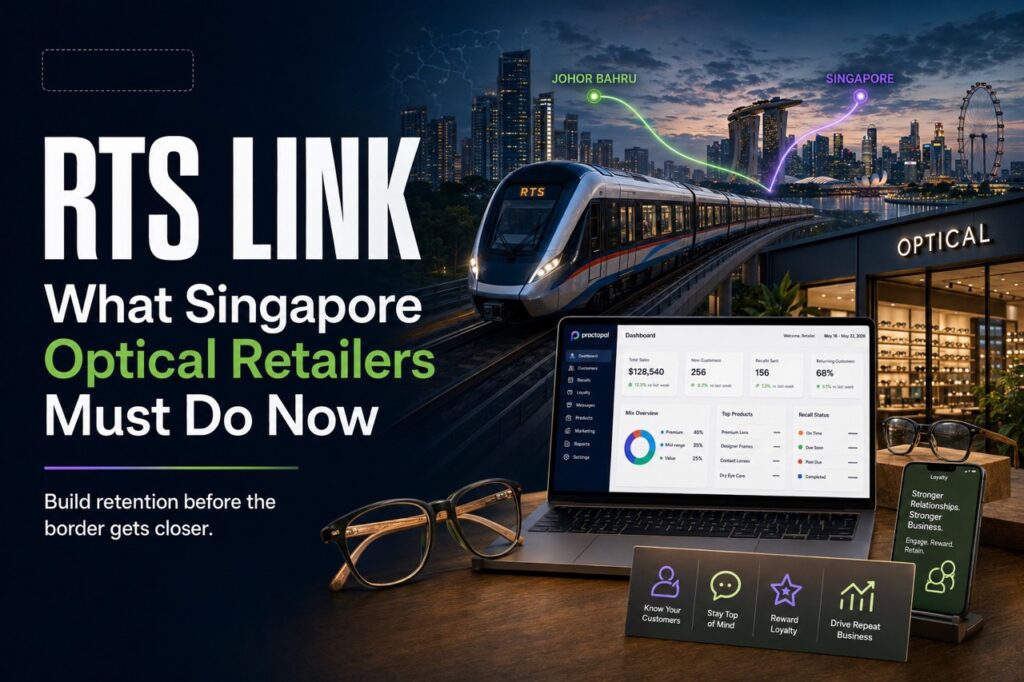
The RTS Link Is Coming: What It Could Mean for Singapore’s Optical Retailers
The Johor Bahru–Singapore Rapid Transit System (RTS) Link could expand the competitive landscape for Singapore optical retailers by making cross-border travel faster and more convenient. It does not mean that every customer will begin buying eyewear in Johor Bahru. It does mean that location and travel friction may become weaker forms of protection.
For many years, an optical store’s most visible competitors were located in the same neighbourhood, shopping centre or part of Singapore. The RTS Link could widen that competitive radius. Singapore’s Land Transport Authority states that the journey between Woodlands North and Bukit Chagar will take about five minutes. The system is designed to carry up to 10,000 commuters per hour in each direction during peak periods, with passengers clearing both countries’ immigration authorities at the point of departure.
That combination of speed, capacity and simpler immigration clearance may make Johor Bahru a more regular part of how some Singapore residents shop, dine and access services. Optical retail will not be immune to this change.
Why the RTS Link matters to optical retail
Eyewear sits at the intersection of healthcare, retail and fashion. A customer may visit an optical store for a professional eye examination, but the final purchase can still be influenced by price, brand selection, convenience, promotions and the overall experience.
When travelling across the border becomes easier, customers may compare more than the price of a meal or a household item. They may also compare:
- Branded frames and sunglasses
- Familiar spectacle lens brands
- Contact lens prices and multipack promotions
- Eye examination fees
- Family eyewear packages
- Perceived service quality and waiting time
The products may be identical or very similar. Malaysia also has qualified eye-care professionals and established optical practices. Therefore, a strategy based only on “our products are better” or “our service is more professional” may not be sufficient.
Which optical purchases may be most exposed?
The most exposed categories are likely to be purchases that customers view as interchangeable. These may include repeat orders of familiar contact lenses, standard prescription eyewear, branded frames available in both countries and purchases where price is the main deciding factor.
However, not every category is equally vulnerable. Singapore retailers can remain strongly positioned where customers value immediacy, continuity and accountability. Examples include urgent adjustments, complex prescriptions, progressive lens adaptation, contact lens aftercare, paediatric eye care and myopia management.
The difference is important: a product can be compared line by line, but a trusted and connected care relationship is much harder to compare.
The key question every optical retailer should ask
If the customer can find a similar product and credible professional care elsewhere, why should they continue choosing our store?
The answer should go beyond friendliness or technical competence. Both are essential, but neither is exclusive. A defensible optical business gives customers several connected reasons to stay:
- The store knows their prescription and eye-care history.
- The team follows up after dispensing instead of waiting for a complaint.
- The customer receives timely reminders for examinations and reviews.
- Appointments are easy to book and manage.
- Benefits and offers are relevant to the customer, not mass promotions.
- The experience remains consistent across different staff members or outlets.
- The customer can see the value of ongoing care, not just the product purchased.
Five actions Singapore optical retailers can take today
1. Centralise customer and patient records
A customer’s prescription, clinical findings, purchase history, product preferences and appointment history should be connected. Fragmented records make it difficult to deliver personalised care and almost impossible to scale it consistently.
2. Build a reliable recall system
Do not rely on customers to remember when they need their next eye examination, contact lens review or myopia-management appointment. Create structured recall rules and track whether reminders lead to bookings.
3. Identify customers at risk of leaving
Look for customers who are overdue, who have not repurchased within their usual cycle or whose family members no longer visit. Early intervention is more effective than trying to win them back after several years.
4. Create recurring care propositions
Move beyond isolated transactions. Contact lens care, family eye care, myopia management and annual vision reviews can be structured as ongoing programmes with clear follow-up and benefits.
5. Measure retention, not only daily sales
Track returning-customer rate, recall conversion, lapsed-customer recovery, appointment attendance and customer lifetime value. These indicators reveal whether the business is building durable relationships.
How PractoPal helps retailers prepare
PractoPal connects point of sale, customer profiles, patient records, prescriptions, appointments, inventory, marketing and analytics in one optical retail platform. Retailers can use this connected data to identify who is due for a review, segment customers, send targeted communications and provide more consistent care across the customer journey.
The RTS Link may influence where customers choose to shop. The right systems can strengthen why they choose to return.
Frequently asked questions
When is the Johor Bahru–Singapore RTS Link expected to open?
Singapore’s Land Transport Authority targets passenger service to begin at the end of 2026. Project schedules may change, so retailers should refer to official updates.
Will the RTS Link definitely reduce sales for Singapore optical stores?
No. Its exact retail impact cannot be predicted. It is reasonable, however, to expect easier cross-border travel to increase customer choice and price comparison. Retailers can prepare by strengthening retention and convenience now.
What is the most important preparation for optical retailers?
Start by centralising customer data and establishing reliable recall and follow-up workflows. These foundations support personalised engagement, continuity of care and measurable retention.
Strengthen your optical business before customer behaviour changes
See how PractoPal can connect your customer records, appointments, recalls, patient care and marketing in one platform built specifically for optical retail.
Source: Land Transport Authority — Johor Bahru–Singapore RTS Link. Accessed August 2026.