
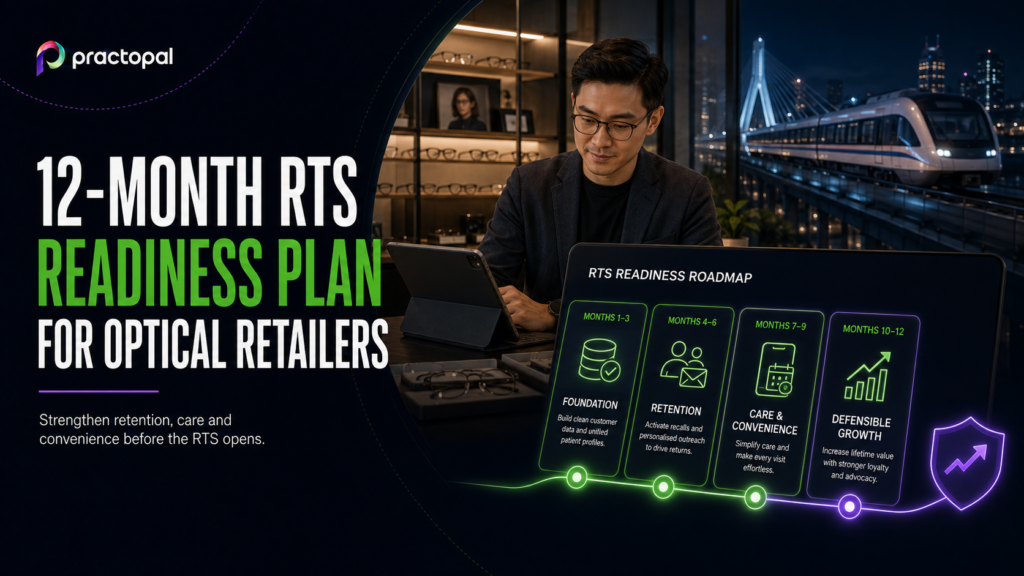
A 12-Month RTS Readiness Plan for a More Defensible Optical Business
Singapore optical retailers should treat the RTS Link as a reason to strengthen customer retention before travel behaviour changes. A defensible business needs accurate data, reliable recalls, connected care, relevant benefits, convenient customer journeys and clear performance measurement. These capabilities take time to build.
The opening of the RTS Link should not be treated as a single event to react to after passenger service begins. Customer loyalty cannot be installed overnight. Neither can a clean customer database, a reliable recall programme or a consistent digital experience.
The exact impact of the RTS Link on Singapore optical retail is uncertain. Some customers may shop in Johor Bahru more frequently; others may continue prioritising convenience, trusted relationships and local aftercare. The sensible response is not panic or indiscriminate discounting. It is preparation.
This 12-month plan provides a practical starting point for independent optical retailers and small-to-mid chains.
Months 1–2: Establish your retention baseline
Before changing your strategy, understand your current position. Review at least the previous 12 to 24 months of customer, appointment and sales data.
Measure these indicators
- Percentage of sales from returning customers
- Number of patients overdue for review
- Recall-to-appointment conversion rate
- Contact lens repurchase rate
- Average time between customer visits
- Number of customers with incomplete contact information
- Voucher redemption rate
- Average transaction value by customer segment
Do not worry if the data is incomplete. The gaps will show what needs to be fixed.
Months 3–4: Clean and centralise customer data
Retention depends on identifying the right customer and understanding their history. Duplicate or fragmented records make personalised care unreliable.
Priority actions
- Merge duplicate customer profiles carefully.
- Standardise mobile numbers, email addresses and communication preferences.
- Confirm appropriate consent for marketing communications.
- Connect prescriptions and clinical records to the correct patient.
- Link purchases, appointments and relevant product details.
- Define mandatory fields for future records.
- Set role-based access to protect sensitive information.
This phase creates the foundation for every recall, campaign and care programme that follows.
Months 5–6: Build your recall engine
A recall should be based on a meaningful clinical or product event, not a generic annual blast to the entire database.
Create separate recall rules for
- Routine eye examinations
- Contact lens aftercare
- Myopia-management reviews
- Ortho-K follow-ups
- Progressive lens adaptation checks
- Relevant product replenishment cycles
- Patients requiring an earlier review based on professional advice
For each rule, define who qualifies, when the first reminder is sent, what the message should say, how the customer books and who follows up if there is no response.
Months 7–8: Develop reasons to remain with your practice
This is the point to move beyond “good service” as a general promise. Create propositions customers can understand and value.
Possible retention propositions
- Family eye-care programme: coordinated recalls and relevant benefits for household members.
- Myopia-management programme: structured reviews, progress tracking and parent education.
- Contact lens care programme: aftercare, replenishment support and timely clinical review.
- Progressive lens support: scheduled adaptation check and adjustment service.
- Customer membership: priority booking, servicing benefits and targeted vouchers.
Document the eligibility, inclusions, duration, responsibilities and renewal process. Avoid vague programmes that depend on individual staff interpretation.
Months 9–10: Remove customer friction
Review the entire journey from discovery to repeat visit. Identify every stage where customers must wait, repeat information or contact the store unnecessarily.
Improve the following
- Online appointment booking
- Appointment confirmations and reminders
- Access to accurate customer history
- Order and collection updates
- Digital receipts and vouchers
- Post-purchase follow-up
- Responsible repeat-purchase requests
- Consistency across multiple outlets
Convenience should not bypass professional checks. Instead, technology should identify when a routine request can proceed and when a practitioner or staff member must intervene.
Months 11–12: Measure, refine and train
The final phase is not the end of the project. It establishes a cycle of continuous improvement.
Compare performance against your baseline
- Has the returning-customer rate improved?
- Are more recalls becoming completed appointments?
- Are contact lens customers returning within the appropriate cycle?
- Have lapsed customers been recovered?
- Which campaigns generated appointments or revenue?
- Which care programmes have the strongest participation and renewal?
- Are staff completing records consistently?
Share results with the team. Retention should not be viewed only as a marketing responsibility. Reception, optometry, dispensing, collection and aftercare all influence whether a customer returns.
The optical retail defensibility framework
| Business requirement | Defensive value | PractoPal capability |
|---|---|---|
| Know every customer | More relevant and consistent service | Integrated CRM and customer profiles |
| Preserve continuity of care | Makes accumulated history valuable | Prescription and patient-record tracking |
| Bring patients back | Reduces dependence on customer memory | Appointments, recalls and reminders |
| Create relevant benefits | Avoids indiscriminate discounting | Segmentation, campaigns and digital vouchers |
| Improve convenience | Reduces friction before and after visits | Connected customer journey and mobile features |
| Support recurring care | Creates meaningful reasons to return | Myopia-management and treatment records |
| Make better decisions | Directs effort toward measurable results | Sales, customer, product and campaign analytics |
| Operate consistently | Protects the experience as the business grows | Connected POS, inventory and multi-store workflows |
What a defensible Singapore optical retailer looks like
A defensible optical retailer does not depend on customers being unable or unwilling to shop elsewhere. It gives them positive reasons to remain.
The practice knows the patient’s history. The team communicates at the right time. The customer can book and receive support conveniently. Care is documented and continuous. Benefits are relevant. Management can measure what is working.
Singapore retailers do not need to position Malaysian providers as clinically inferior, nor assume that every customer will cross the border. They should accept that customers will have more credible choices—and build a business capable of earning the next visit.
Frequently asked questions
When should optical retailers begin preparing for the RTS Link?
They should begin now. Data cleaning, workflow implementation, staff training and customer-programme development can take several months before they produce consistent results.
What should a small optical store prioritise first?
Start with accurate customer records and a reliable recall process. These provide an immediate foundation for continuity, personalised engagement and repeat visits.
How can PractoPal help with RTS readiness?
PractoPal connects optical POS, inventory, CRM, patient records, appointments, marketing, vouchers and analytics. This helps retailers implement and measure the customer-retention actions described in this plan.
Start building your RTS-ready optical business today
Book a personalised demonstration and see how PractoPal can help your store strengthen retention, continuity of care, convenience and operational visibility.
Source: Land Transport Authority — Johor Bahru–Singapore RTS Link. Accessed August 2026.